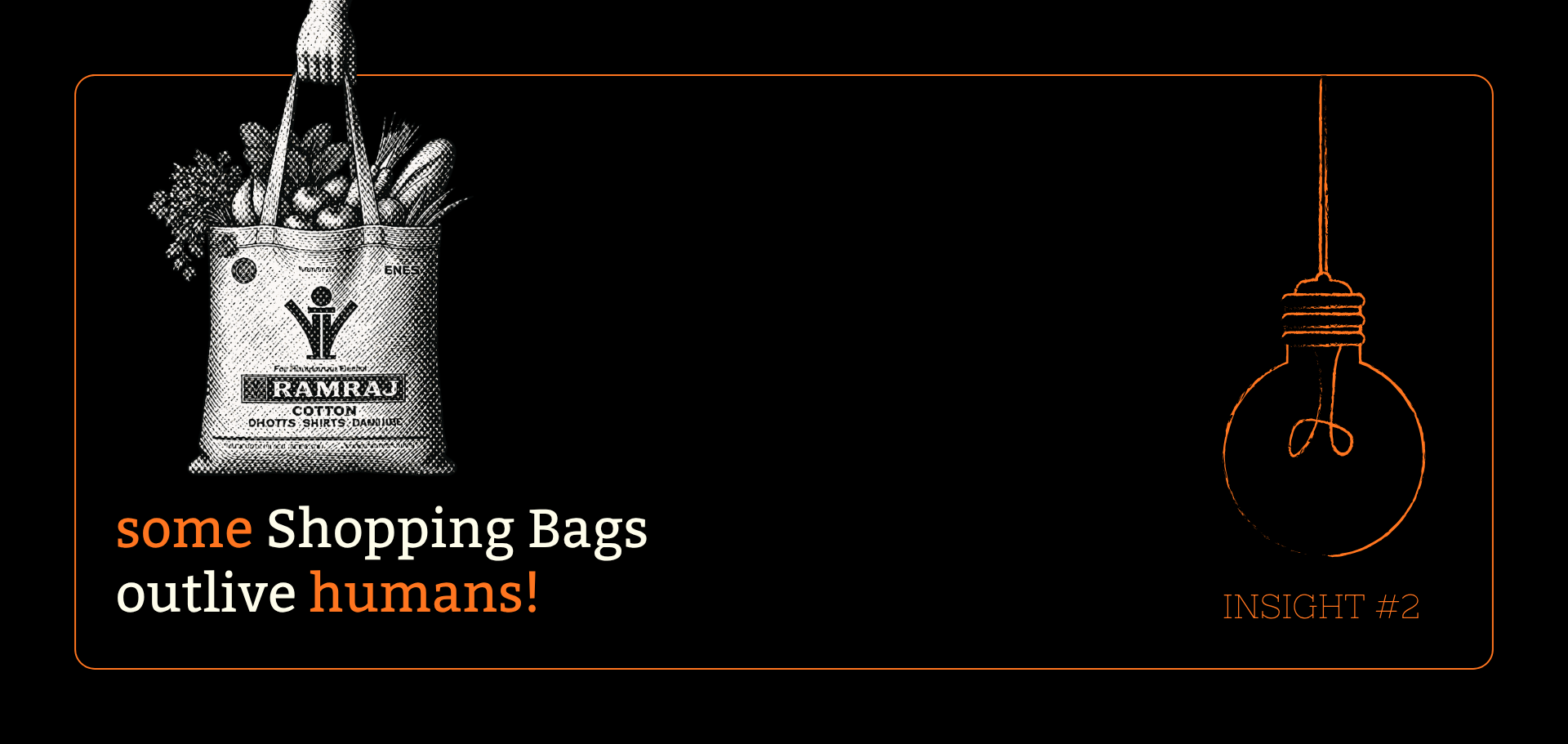
insight #2: Some Shopping Bags Outlive Humans
ddhenuka r
5 min read
June 05, 2026
There is a carry bag in almost every South Indian home that is older than at least one person living in it. Nobody knows by how much. Nobody knows which wedding brought it home, which Pongal, which completely unremarkable Tuesday when someone needed a new veshti and came back with one. The bag was definitely not the point of the trip.
And yet it is the only thing from that trip still in the house.
It lives on a hook in the kitchen. It does the Tuesday groceries. It has been to the pharmacy, the neighbour's house, the market, that relative three streets away who always needs something. It moved when the family moved. It has never been chosen on purpose and never thrown away on purpose. It is just there — the way certain things in a home simply are, like the spare key nobody remembers making or the bowl that has always been the curd bowl.
Anyone who grew up in a South Indian home knows this bag. Not this specific one, but one exactly like it. Cream-coloured. Sturdy. Name printed cleanly on the side. A Ramraj Cotton bag or a Sundari Silks bag that arrived with a purchase nobody quite remembers and stayed for reasons nobody quite discussed.
Meanwhile, every other bag that passed through the same home — the tote from some brand event, the supermarket bag, the pretty gifted one — has long since split and been forgotten. The silk store bag is still on the hook. Living its best life. Rent free.
So what is going on with this bag?
The paper is thick. The handles hold at the stitch. The base doesn't buckle under a week's worth of vegetables. No brief produced this. No brand manager greenlit "outlast the customer's grandchildren" as a packaging objective. Somewhere in the supply chain, someone just quietly decided the bag should be built properly. That decision — unglamorous, unminuted, probably made in under thirty seconds — has been compounding in kitchens across South India for decades.
Every time the bag leaves the house, it is doing something no media plan can buy. It goes places campaigns never reach. It is seen by people who were never the original customer. And it doesn't show up making claims. It shows up as evidence. A bag that is fifteen, twenty, twenty-five years old and still holding vegetables is that many years of proof, out in public, saying absolutely nothing and meaning everything.
And somehow, no brand has noticed.
Every season the campaigns run — right face, right fabric, right occasion, big feelings. All of it aimed at thirty seconds before purchase. None of it aimed at the thirty years that follow. Which is, to put it gently, a bit of a waste.
Here is what brands — especially newer ones — could actually do with this:
Treat the bag like a product, not an afterthought. Look at what you're spending on the bag versus what you're spending on the campaign. For most brands, this ratio is quietly embarrassing. A bag that lasts ten years is ten years of brand presence the media budget didn't have to pay for. Worth thinking about.
Make it and say so. Stamp the year of manufacture on the base. Made in 2025. Tiny. Almost silly. But a customer who reads that in 2040 knows exactly what the brand was willing to promise — and whether it kept it. No tagline works that hard for that long.
Let the bag be the whole campaign. Find the oldest one still in use in a real home. Photograph it exactly where it lives — on the nail, wedged between the vessels, balanced above the almirah. Put the year it was bought in the corner. Stick it on a hoarding. No copy. No model. No product shot. Just the bag and the year. People in Chennai, Coimbatore, Bengaluru, Kochi will stop and look. They will photograph it and send it to their mothers. Because it is the first time a brand has looked at something they do every single day and said: we see it too.
Say something at the counter. A small card with every bag: "This bag is built to outlast the occasion." Not a tagline. A dare the brand is now publicly committed to. The bag stops being packaging and starts being a promise the customer carries home — and probably uses to carry onions for the next fifteen years.
Brands like Ramraj and Sundari Silks never set out to build a legacy object. They just made a good bag. And that bag has been doing their brand work for decades — in homes across South India, on hooks in kitchens, since before some of us were born.
The bag never needs a campaign. It just needs to be made well. That, it turns out, is enough.
References
- Ramraj Cotton — About Us
- From Entry Denial Over Dhoti to Rs. 2000 Cr Success: Ramraj Cotton's Global Ethnic Wear Impact
- India Ethnic Wear Market Size & Outlook, 2023–2030
- Paper Bags — Latest Price, Manufacturers & Suppliers
The brand names mentioned in this blog belong to their respective owners. This is an independent editorial piece and is not affiliated with or endorsed by any of the brands mentioned. All views are the author's own.