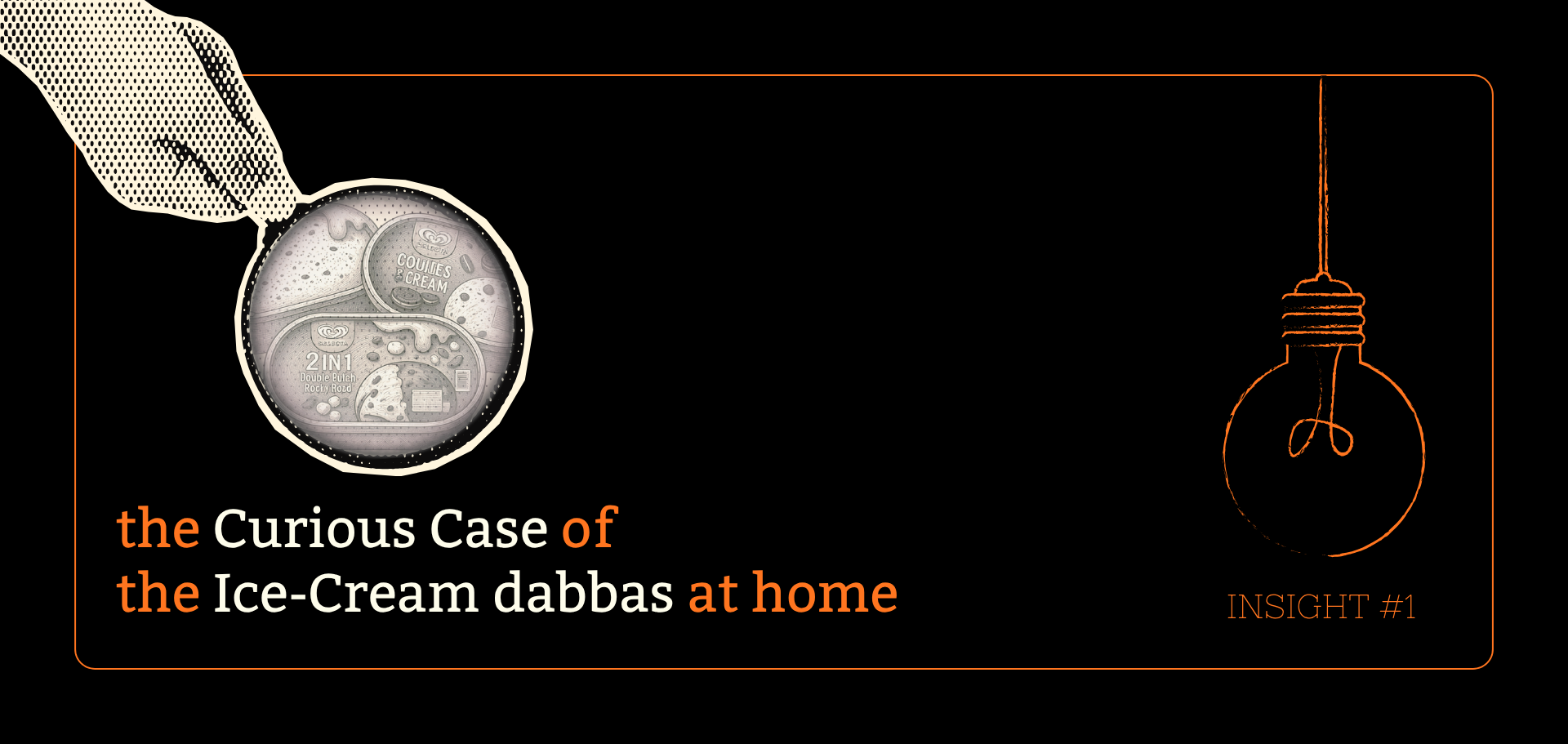
insight #1: The Curious Case of the Ice Cream dabbas at home
ddhenuka r
4 min read
May 05, 2026
Open any freezer in any Indian household and you will find it. Sitting there, full of promise, wearing the logo of your favourite ice cream brand. You reach for it. You open it.
Frozen soup pulp stares back at you.
We are willing to bet that every single person reading this has lived some version of this moment. The Kwality Walls tub holding leftover sambar. The Amul dabba with a week's worth of frozen kothamalli. The fancy Naturals container repurposed for raw tamarind.
The ice cream dabba in an Indian household is a Schrödinger's box. It could be ice cream. It could be your amma's emergency rasam. You simply do not know until you open it.
What is it about ammas, appas, paatis, thaathas, aunts, and uncles making the ice cream dabba their container of choice for everything that is not ice cream?
Pure jugaad.
The dabba is airtight, freezer-safe, decently large, and free. Indian households figured out sustainable packaging long before it became a LinkedIn buzzword.
Ice cream brands in India have spent crores telling us their product is joy, celebration, summer, childhood. Amul built campaigns around family bonding. Cornetto owns the ritual of unwrapping. But not one brand has acknowledged the afterlife of their product - the second, longer, more loyal chapter of the dabba's life inside the Indian home.
The dabba outlives the ice cream by years. It stores dough, chutneys, leftover curry. It travels in a relative's bag going abroad, carrying home food and homesickness together. It becomes a memory, that container you sneaked open as a child, only to find cooked rice waving back at you.
No brand has meaningfully owned this insight. And that is a massive missed opportunity.
Because this insight does not live in just one place. It lives everywhere the consumer does.
So what could a brand actually do with this insight?
The packaging: This by itself is the most underused canvas here. Printing "Congratulations, you finished the ice cream. Now what's going in here?" on the inside of the lid costs almost nothing and becomes the most talked-about thing on the pack. A limited edition dabba with side markers, "Ice cream level," "Leftover curry level," "Amma's mystery level" and suddenly it is not just packaging. It is something people photograph.
On a hoarding: The idea needs almost no words here. "This one actually has ice cream in it" in Tamil, in Telugu, in Hindi, in Kannada is the kind of OOH that earns its space because people stop to photograph it. No celebrity. No elaborate tagline. Just the truth, said plainly, in the right city.
At the point of purchase: A shelf talker that reads "Buy two. One for now. One for amma to store the rasam in" turns a routine retail moment into something genuinely warm. That builds more brand affinity than any discount sticker ever will.
On television: A 30 second TVC that opens on a family freezer, someone reaching in with hope, opening the dabba, finding frozen idli batter, cutting to the logo with "Ours actually has ice cream" would land in every living room in the country. Because every living room has lived that moment.
India's ice cream market is projected to grow from ₹30,000 crore to ₹50,000 crore by 2028. Every brand is chasing the same summer window with IPL tie-ups, celebrity faces, and quick commerce deals. All of it works. But the brand that builds real cultural equity will be the one that says: we see you, we see your amma, and we know the dabba is now holding her leftover avial.
The dabba does not discriminate. It simply stores.
The sharpest brand insights work the same way, hiding in the most ordinary corners of everyday life. Spot them, and the brief writes itself.