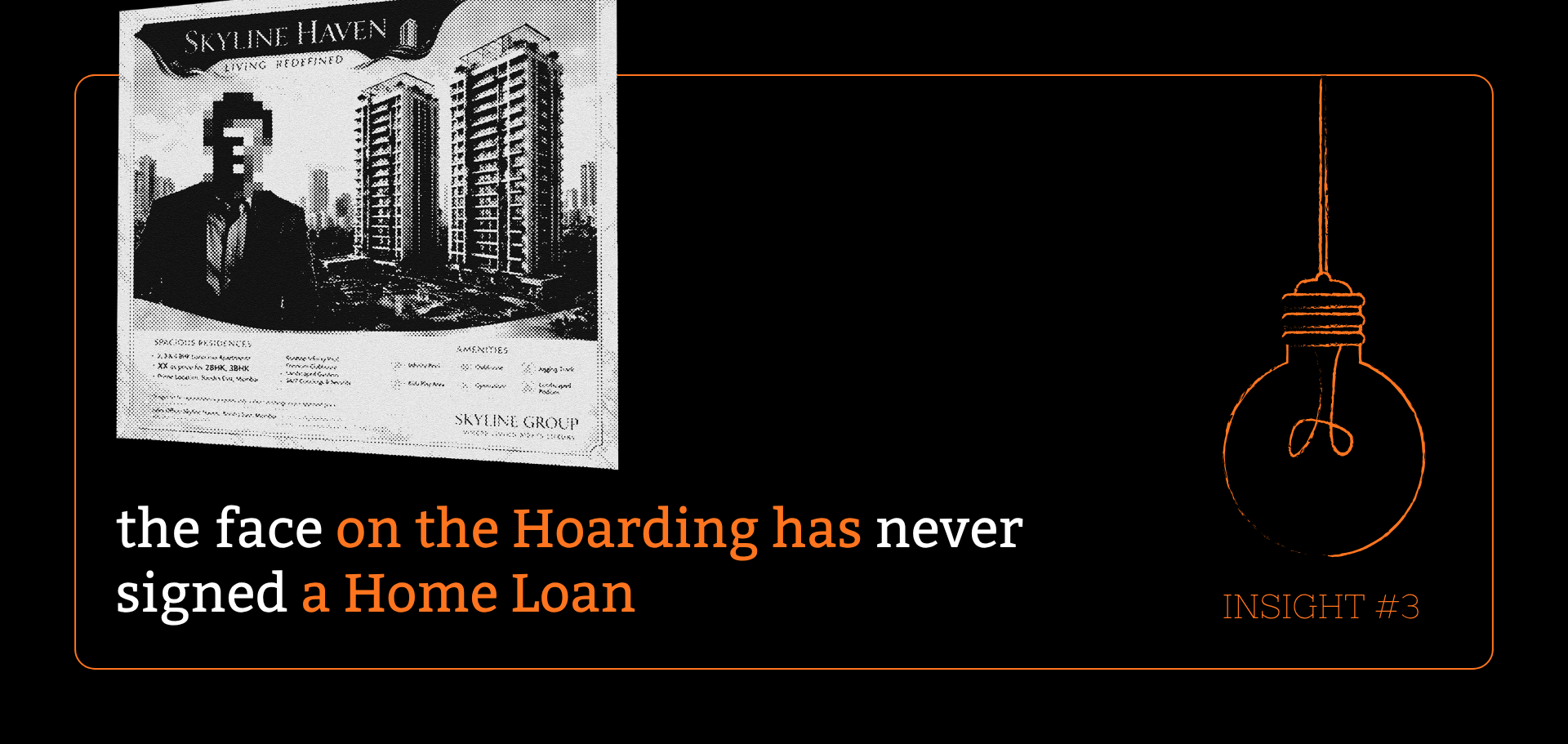
insight #3: the face on the hoarding has never signed a home loan
ddhenuka r
6 min read
August 07, 2026
Drive down OMR on any given day and you will pass at least four billboards before the next signal. A villa with a British-style facade, upward of a crore and a half, fronted by a woman in a red gown who has never seen the site. A luxury tower promising "the celebrity life," fronted by a designer whose actual studio is in Mumbai. A composer, celebrated for melody, is now the face of a thousand under-construction homes across five localities. The faces change every few months. The billboard never quite explains why that particular face is standing in front of that particular building.
Here's the part that actually doesn't add up: a celebrity isn't just a face. A celebrity is a brand, built the same way any brand is, through years of consistent choices and public behaviour, until their name carries a specific, recognisable set of values. So when a builder signs one on as "brand ambassador", not a poster model, an ambassador, it isn't simply buying eyeballs. It's asking one brand to vouch for another. That is third-party validation, and validation only means something if the two brands' values actually line up. If they don't, all that's left is a famous face standing next to a building, which gets attention, and nothing else.
The precedent everyone forgets.
In 2002, Amitabh Bachchan was cast for the Pulse Polio campaign.
Not for his stardom.
But for one specific piece of his own brand: the "Angry Young Man," built on moral authority and the discipline to make you do the right thing. Ogilvy's Piyush Pandey chose that piece on purpose because the message needed urgency, not charm. UNICEF's own funders were unsure a celebrity could get away with scolding people. The result: Indian audiences didn't read the irritation as arrogance; an elder getting angry felt like it was for their own good. India went from 1,600 polio cases in 2002 to zero by 2014.
Two brands.
Values that matched.
Doing what validation is supposed to do.
Now ask what an Indian film star's brand is actually built on.
Glamour.
Drama.
A life more exciting than the one the audience currently lives.
That's not a flaw; it's the whole job, and it's why the same names work brilliantly for
A soft drink.
A fashion label
A festival campaign.
But hold that brand up next to what a home purchase actually needs said: permanence. Something that holds up long after the excitement wears off, and the two aren't just mismatched. They're close to opposite.
This isn't a casting error. It's a category error.
Real estate has borrowed the celebrity-ambassador play-book wholesale from FMCG and fashion, where glamour is the product, without pausing to ask whether the same logic holds for a purchase that's the biggest, slowest, most considered decision most Indian households ever make.
Which is exactly why it reads as patchwork.
Glamour, stapled onto concrete.
Nobody signing a fifteen-year home loan is doing it because a familiar face waved from a hoarding at a signal. Attention? sure. Everyone looks. Trust? No.
And trust was the entire point of hiring a "brand ambassador" in the first place, as opposed to just a model.
The strange part is how big and sophisticated these developers are while still making this call. Industry coverage is candid about the reasoning: regional developers reach for A-list names to buy trust fast because a home is one of the largest financial commitments a household will ever make. Wanting trust fast is a fair problem to solve for.
The mistake is the solution.
Copying a celebrity-ambassador tactic built for a different kind of category, instead of asking which celebrity's actual brand says the thing this project needs said.
What a real estate brand should actually do instead.
Ask what the celebrity's brand stands for before asking how famous they are. If the values don't overlap with permanence, judiciousness, or trust, the endorsement is decoration, however big the name.
Look past the usual five. Brand strategist Ambi Parameswaran, founder of Brand-Building.com and former CEO of FCB Ulka, was asked who else could carry Bachchan-level trust and named Rahul Dravid, Sunil Gavaskar, and M.S. Dhoni without hesitating. Dravid has been called "The Wall" for two decades, a brand built entirely on not collapsing under pressure. That is nearly the literal thing a builder needs said. No developer has used it.
Be honest about what the face is actually doing. If it's pure attention, announcing a launch, entering a new city say that with the media plan, not with language like "designed by" or "celebrity life" that implies a values match that was never built.
Spend the rest of the budget where trust is actually earned. RERA (Real Estate Regulatory Authority) registration number, possession history, escrow status — put in front of the buyer at the point they're already leaning in. No borrowed brand, however well matched, replaces that.
India's real estate industry is projected to more than triple to nearly ₹88 lakh crore by 2030, and most of that growth will keep chasing the same shortlist of stars to announce itself in a new city.
Some of it may earn a glance.
Almost none of it earns the thing a fifteen-year mortgage actually asks for.
Real estate hasn't found its "Angry Young Man" yet. It's been too busy renting famous strangers to notice it needs a brand that actually believes what it's selling.
Before any brand hands its face to someone else — a spokesperson or a category it hasn't earned, the values need checking first, not the fame. That's the first thing we push on before a rupee goes toward casting a face.
If you're weighing a similar call, we'd be glad to think it through with you.
References:
- Why 83-year-old Amitabh Bachchan remains the only face brands trust for a hard sell
- Brand Saga: When 'Do Boond' helped make India Polio free
- Why real estate brands tap A-list celebrities for trust & visibility
- Urbanrise unveils 'Welcome to the Celebrity Life' campaign featuring Gauri Khan for Whispers of Sky
- India real estate industry to hit US$ 970 billion by 2030
The brand names mentioned in this blog belong to their respective owners. This is an independent editorial piece and is not affiliated with or endorsed by any of the brands mentioned. All views are the author's own.